
CZUR ET MAX vs Shine800A3 Pro: Books or Documents?
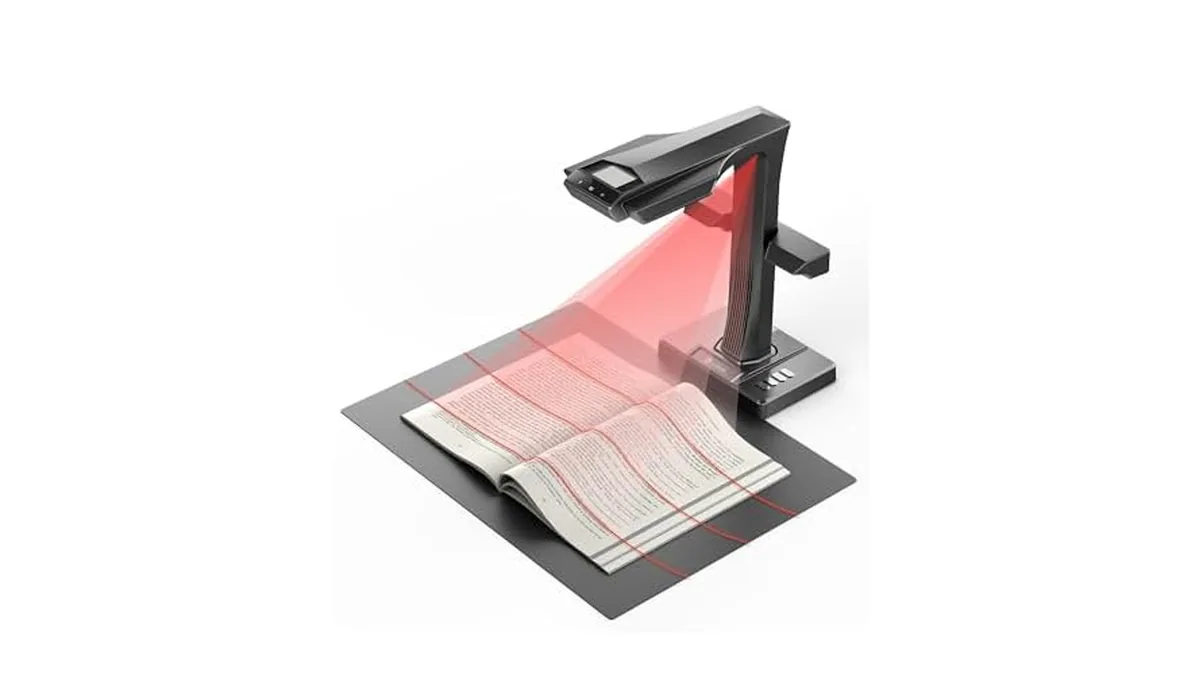
Choose the CZUR ET MAX when the paper is bound: a 38MP camera, curve flattening, and reference thickness up to 50 mm at A4. Choose the CZUR Shine800A3 Pro when the paper is flat and sometimes larger than letter size: an 8MP camera, autofocus, and pages up to A3 (420 × 297 mm). Both export searchable PDF, Word, and Excel. The split is books versus loose sheets.
The two scanners at a glance
| CZUR ET MAX | CZUR Shine800A3 Pro | |
|---|---|---|
| Sensor | 38MP CMOS, 7168 × 5376 | 8MP CMOS, 3280 × 2460 |
| Stated resolution | About 410 dpi default | About 340 dpi at A4, about 245 dpi at A3 |
| Scan area | Flat pages up to A3 (420 × 297 mm); bound books up to A4 per page | Flat pages up to A3 (420 × 297 mm) |
| Thickness | 35 mm at A3, 50 mm at A4 (reference) | Listed as a single page; this series has no laser curve flattening |
| Speed (CZUR) | About 1.5 seconds per flat page or two-page spread | Under 1 second per page |
| Lights | Top LED plus side lights | Top LED with stepless brightness; no side light |
| Book tools | Three laser lines for curve flattening, spread split, fingertip erasure | None of those book tools |
| Controls | Device button, software, hand button, foot pedal | Device button, software, foot pedal |
| Other | USB 2.0, HDMI output for presenting | USB 2.0, adjustable height, autofocus, 1 kg net |
| Weak fit | Mostly loose single sheets, or a desk that cannot take a large unit | Bound books, magazines that must stay open, or work that needs HDMI presenting |
When the ET MAX is the right desk unit
The ET MAX is the scanner in this lineup for bound paper. CZUR lists a 38MP sensor and about 410 dpi by default. Flat sheets still go up to A3. Bound books are listed up to A4 per page, with a reference thickness of 50 mm at that size and 35 mm at A3.
Three laser lines trace the curve of an open book, and the software uses that line to flatten the page and straighten the text. It can split a spread into two pages and erase fingertips at the margins. Side lights help with glare on glossy paper. A foot pedal, a hand button, and auto-scan on page turn keep your hands on the book. HDMI output can send a live image to a monitor or projector without a computer in between.
Stated capture is about 1.5 seconds per flat page and about 1.5 seconds per two-page spread. Real speed still depends on how quickly you turn pages. Exports include JPG, PDF, searchable PDF, Word, Excel, and TIFF converted from JPG, with text recognition in 180+ languages. Systems listed are Windows XP/7 or later, recent macOS, and Ubuntu 20.04 to 24.04.
The ET MAX is a large desk unit, not a portable fold. Bound-book support stops at A4 per page, so an oversized atlas may need to be scanned in sections. If the books are mostly thin and you want a unit that folds away, the CZUR Aura Pro is the lighter book scanner, with a 14MP sensor. A same-family resolution step is walked through in CZUR ET MAX vs ET24 Pro.
When the Shine800A3 Pro is enough
The Shine800A3 Pro is for flat paper that sometimes runs larger than letter size. CZUR lists an 8MP sensor, a capture time under 1 second, pages up to A3, adjustable height, and autofocus. Height is how it reaches the A3 area. Autofocus is why the camera can stay sharp from a business card to a full A3 sheet; A4-only Shine models use fixed focus.
It does not flatten book pages and has no side light. CZUR’s spec table gives the maximum document thickness as a single page. A book placed under it will show a curved gutter. (One CZUR product page also mentions content up to 1.96 in (50 mm) thick; the spec table contradicts that, so this comparison follows the single-page figure.) Glossy paper may pick up glare from the top light; turning the light down is the published workaround.
Resolution drops at A3: about 245 dpi against about 340 dpi at A4. That is enough for text and recognition on invoices, worksheets, and contracts. It is a weaker choice for detailed artwork at full A3. Software still crops and straightens, can combine front and back, and runs text recognition into searchable PDF, Word, or Excel in 180+ languages. A foot pedal is included. Weight is 1 kg net. Systems listed are Windows XP/7 or later and the same macOS versions as the ET MAX; Linux is not listed on this Shine page.
Which one to buy
- Are textbooks, ledgers, or bound reports a regular part of the work? Buy the ET MAX.
- Is the pile mostly loose contracts, invoices, worksheets, or A3 drawings? Buy the Shine800A3 Pro.
- Do you need HDMI output as a document camera? That output is listed on the ET MAX, not on the Shine.
- Do you need to fold the scanner away? Neither of these is the folding pick; look at the Aura Pro.
- Is Linux (Ubuntu) a requirement? The ET MAX lists Ubuntu 20.04 to 24.04. The Shine page does not.
You do not need both unless the work splits into bound books and high-volume flat A3. For the rest of the lineup, use the CZUR review, book scanners, and document scanners.
Bottom line
The ET MAX is the bound-book machine: 38MP, about 410 dpi, 50 mm at A4, curve flattening, side lights, and HDMI presenting. The Shine800A3 Pro is the flat-page machine: 8MP, under a second per page, A3 coverage with autofocus, and a 1 kg body, without book-flattening tools. Pick the ET MAX if the spine stays intact, and the Shine if the paper already lies flat.